
The Bechdel Test
The Bechdel Test (sometimes referred to as the Bechdel-Wallace Test) is frequently held up as a standard for female characterisation. You may have seen it doing the rounds, especially if you’ve read B2W’s free eBook, How Not to Write Female Characters.
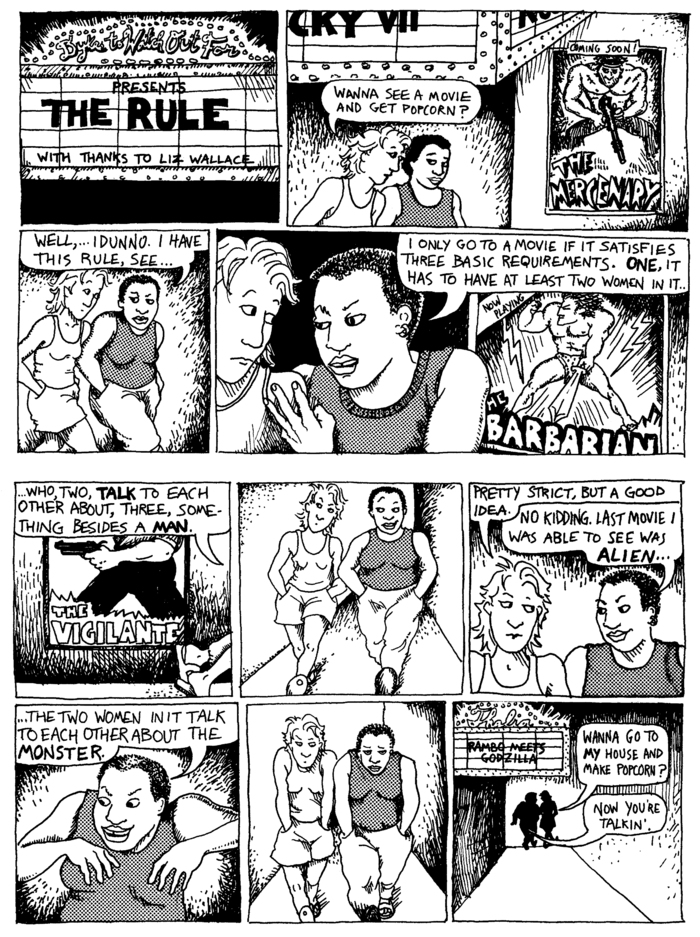
The Bechdel Test is based on the 1985 comic strip, Dykes To Watch Out For by Alison Bechdel. It’s frequently used to measure effective female characterisation in film and other fiction. The test asks whether a work …
- features at least two female characters
- who have a conversation about
- anything other than a man
Here’s the comic strip … yes, it’s that short. No, there isn’t another part that’s been cut off. You’re not missing anything. And yes, Alison Bechdel herself even confirmed it was a joke.
It’s not long before self-professed feminists will crash into threads for articles like this one. They will claim The Bechdel test is a ‘low bar’ for female characterisation.
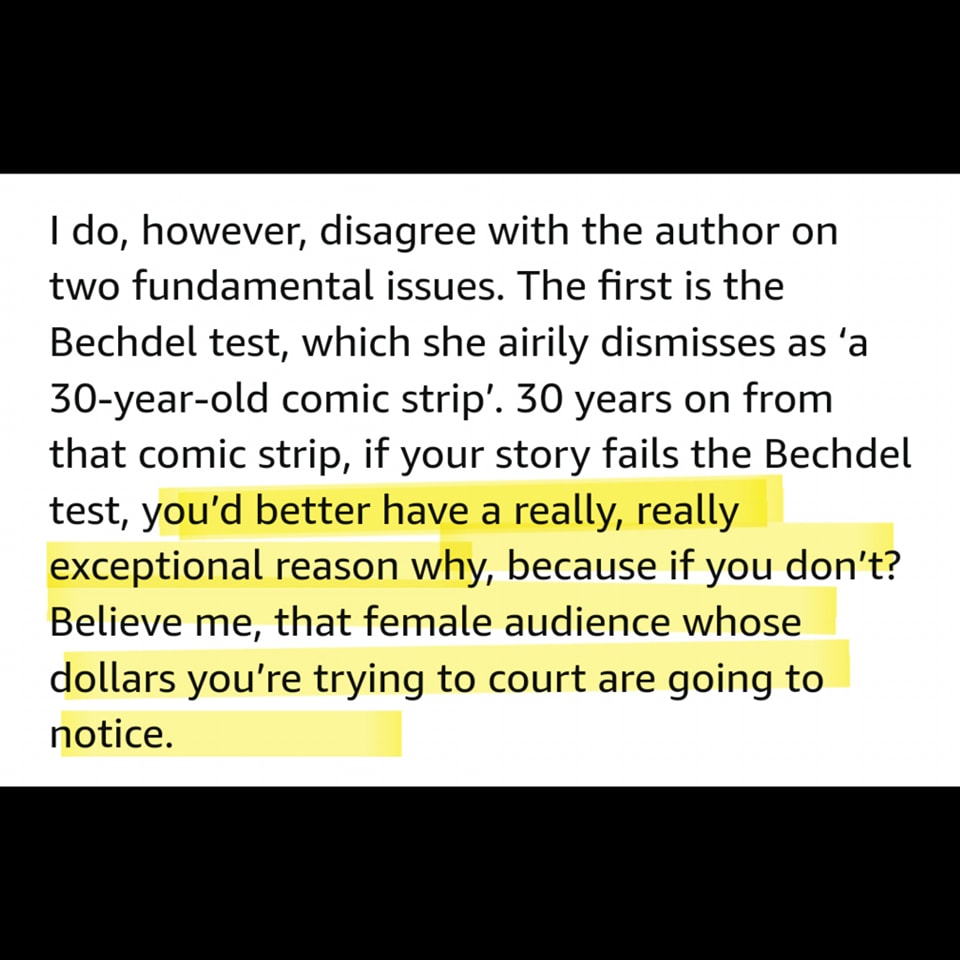
They will also insist it’s the very least any self-respecting storyteller can do. Here’s several who’ve got up in my inbox (and not in a sexy way) below.
1) Audience members are DEMANDING it?
Erm, no they’re not. In fact, unless you’ve studied Film, English Literature or Gender Studies (or read this blog before!), you won’t even have heard of it.
Yet most people will have strong opinions about what makes effective female characters. This will be based on their own real-life experiences and worldview. It will also be based on hundreds – often thousands – of hours of books, movies and TV shows they’ve consumed.
This means writers will ALSO have ideas about what makes effective female characters … and get this: there is no designated gold standard for ANY characterisation!
Anyone who says there is this mythical, hocus-pocus gold standard? They’re lying to you and themselves. Fact.
2) Counting Women??
It is surely common sense that merely COUNTING female characters does not deliver fantastic female characterisation … yet here we are.
Of course, there was a period in the mid-noughties in which female characters were at a premium. When they did appear – usually in ensembles – they were the ‘girl character’, differentiated by the sole virtue of ‘being female’.
Yes, this was frustrating. I even referenced in the 2013 version of my Thriller Screenplays book. However, it was short-lived, which is why I was able to rewrite and update that whole section for its 2023 second tenth-anniversary edition.
In other words, Hollywood course-corrected as its wont to when audiences vote with their wallets. This is because Hollywood follows the $$$. Always has; always will.
3) Literally Pointless conversations
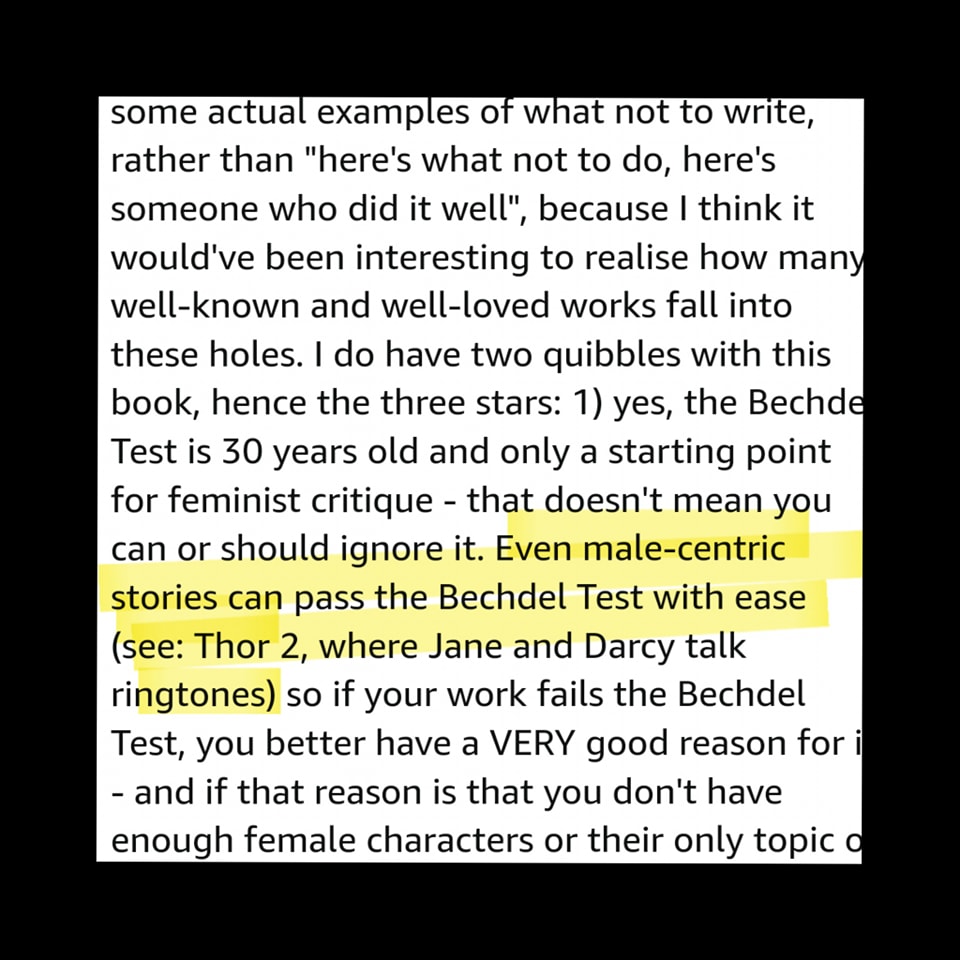
Note how this next screenshot posits that ‘even male-centric stories can pass Bechdel with ease’. The writer suggests that Thor 2 is a GOOD example of this.
Now, Thor 2 (aka Thor: The Dark World) is a very bad movie, but let’s put that aside for a moment. The groundbreaking, Bechdel-passing moment the reviewer suggests is Jane and her friend talking about *checks notes* RINGTONES? Seriously??
4) Role Models
Pro-Bechdel people seem to be very confused. On the one hand, they will claim that female characters should be ‘characters, who happen to be female’ … then moments later, they will insist the very existence of certain female characters is ‘problematic’.
When this logic flaw is pointed out to them, they tend to double-down. They will claim the existence of Bella Swan from Twilight, Ana from Fifty Shades, *insert contentious female character here* apparently contributes to the dehumanisation of women.
Whilst some female leads are more contentious than others, I’ve now seen this claim applied to just about every single major female lead. Yet male characters can do just about anything in stories and STILL be ‘just’ a character. Funny, that.
Pro-Bechdel types tend to overtly say or imply that female characters should be ‘role models’. They will wring their hands and make all sorts of points, but basically we’re dealing with ‘But what about the chiiiiiiiildren???’
Yet here’s the thing. However much someone hates a character, someone else loves them.
This won’t be because that latter person is ‘stupid’, ‘naive’ or ‘too young’ to understand the nuances either. Sometimes they love that character DIRECTLY BECAUSE OF the things you hate, for reasons that are personal to them. Now what??
Also, however ‘problematic’ a character’s behaviour is, most people realise it’s JUST a story. Those that don’t? Well, they have waaaaaay more problems than female characterisation.
5) Domestic Abuse
But this is where the pro-Bechdel types TRIPLE down. They may claim that yes, most people get that it’s ‘just’ a story … but the reason they’re complaining is because they feel more Bechdel-passing stories will help prevent domestic abuse.
No, I’m not exaggerating. Here’s one who does just that …
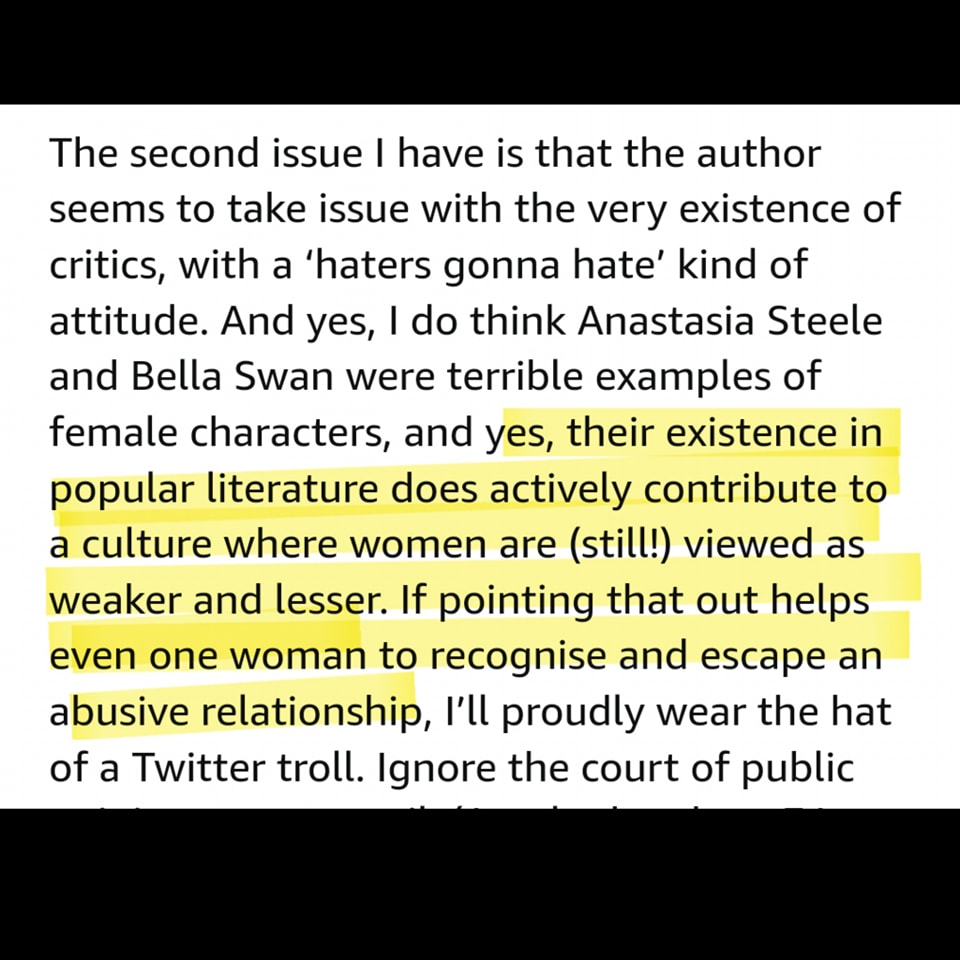
The idea that Bechdel-passing stories will prevent domestic or relationship abuse is of course risible. First up, there is no substitute for outreach and education, not to mention resources to help people escape bad situations. (YES, help like this has been at a premium thanks to austerity in the UK … Plus it will become even more so in other countries like the USA thanks to you-know-who. And NO, a ‘good’ or a ‘bad’ female character can’t help people avoid bad situations).
Why? Well, first of all, many of us are born into domestic abuse situations. Countless studies have concluded the relationships parents model for children affect their future situations (because: obviously). So, if our baseline growing up is skewed thanks to our parents’ deeply dodgy relationship, then it literally doesn’t matter what we see on TV, at the cinema or read in books.
Lastly, as someone who was in a domestic abuse situation for many years, I can confirm female characterisation – bad OR good – did exactly squat in hindering OR helping me escape it. But making the above lofty claim makes the pro-Bechdel types feel warm and fuzzy and like they’re ‘doing something’ about the terrible injustices done to women and girls worldwide. Sigh.
Bechdel Is Not A ‘Low Bar’ … It’s Not A Bar At All
The short version is, the test is too broad to be any much use at all. It’s no accident the vast majority of pro-Bechdel people are academics or other people who don’t write. As storytellers, we need to be super-wary of quick fixes and tick-the-box BS like this.
So next time you see a femcritter blithely claiming The Bechdel Test is a ‘low bar’ all storytellers should achieve, remember this post. Here’s why the test simply does not work …
- We only need two female characters. They don’t have to be leads (protagonists or antagonists). Hell, they don’t even need to be secondaries. They could be random peripherals for the purposes of the test and still pass.
- They don’t need any actual personality. This is such a massive craft issue. Tropes, archetypes, motivations … none of it matters as long as they talk about some random shit (such as ringtones!).
- No other representation required. No LGBTQ, no BIPOC, no disability or neurodiversity, NADA. If the female characters don’t need a role function, or any sense of personality, this has a knock-on effect. In fact, it feels quite sinister to me that ‘being female’ becomes a character biography! It also invites exactly what we don’t want: the return of ‘The Girl Character’!
- Bechdel-passing stories do NOT save women and girls. I wish they did. They could have saved me some really traumatic life-shit.
- No, audiences don’t want Bechdel-passing stories as standard. Most don’t even know what it is. Yes, they want nuanced, complex female characters … but Bechdel isn’t going to cut it. So what will?
It’s All About Writing Craft, NOT Tests
Look, I’ve said it before and I’ll say it again. If a writer has never thought about female characterisation before, then starting with Bechdel might be a good idea. Be my guest, it’s a free country, etc.
But counting women or dropping literally pointless conversations into a piece is not going to deliver great female characters. There’s just one thing that DOES work …
… understanding how writing craft actually works and putting it into practice.
And yes, it DOES take practice. No one can create fantastic characters straight off the bat … and even when we do, someone will come along and tell us how ‘problematic’ our creations are!
But paying attention to our writing craft remains the ONLY way to create complex, nuanced female characters with a variety of role functions and motivations.

You have it right. Two women who don’t matter to the story will pass that test. We need more than two women talking about BS. Making women who mean something and aren’t one-dimensional is what is needed and I’ve seen way too many of those in books lately. Any AI story would pass that test and still be horrid. And for that reason, unless I get to know the author and know that they aren’t doing an AI book, I’m not buying indie books unless it’s on BookBub. I guess that tells you the quality of a lot of books.
The Bechdel test isn’t even a low bar. It is in a hole and would still pass in some movies and books. You need a well rounded character with agency and a goal and motivation. It doesn’t matter what she is talking about if you don’t have that.
THANK YOU! Gawd it’s so tedious how people hang on to this outdated, pointless metric rather than do the hard work of **crafting** female characters with agency and motivations of their own.