
The Serpent on BBC1
The Serpent is a 2021 BBC limited series about a real-life serial killer Charles Sobhraj who befriended, robbed and murdered dozens of young western backpackers in Asia in the 1970s.
Its eight 60 minute episodes got 6-8m views when it first aired in 2021 and it seems to be developing a cult following. It spans decades, crosses continents, and involves multiple cases of mistaken and stolen identities. It could so easily be baffling, yet it is effortlessly bingeable and often has an almost hypnotic, dreamlike feel.
Five examples of top-class craft in the pilot episode of The Serpent
I enjoyed it so much I pulled the pilot apart to see if I could work out how The Serpent worked.
In summary, it seems to totally ace the following aspects of craft …
- Making us care.
- Maintaining a relentlessly compelling Story Chain.
- Combining multiple nonlinear story strands.
- Providing just enough factual historical context to keep it feeling 100% real, and no more.
- Reaching a satisfying conclusion which is also a massive cliffhanger.
— and I wanted to work out how, so I did. Ready? Let’s go …

Pulling The Serpent’s script apart
Obviously as a Banger, once I’ve watched something I like, I watch it again soon after! This time, with a pencil and pad on one knee and the remote control in the other.
But the problem I have with things I really love is that I get caught up in it and completely forget to hit the pause button.
So I tracked down the shooting script for the pilot episode of The Serpent on BBC Writers Room and imported it into Final Draft. Then I tidied up the inevitable formatting errors created by the transcoding; stripped out the production stuff like the scene numbers, plus the inserts and deletions.
Shooting script vs. the episode as broadcast
Then I read it all the way through in one go – and found that it felt quite differently about some of the main characters. I wondered if that was me reading stuff into the script that wasn’t there … ie. me trying to direct it in my head instead of feeling for the writer’s intentions?
So I watched it again with the script on my lap and realised there were some substantial differences.
Entire scenes and characters have been cut and themes have been recalibrated. I haven’t revisited the rest of the series yet, so it’s possible that some of the scenes and characters cut from the pilot occur in later episodes in the form of flashbacks. The narrative jumps back and forward a lot – but the theme changes are noticeable.
Reverse engineering the script as broadcast
I knew there were more differences that I couldn’t quite put my finger on. So I went through the whole pilot — page by page in Final Draft, minute by minute on BBC iPlayer — changing the script to exactly match the broadcast programme.
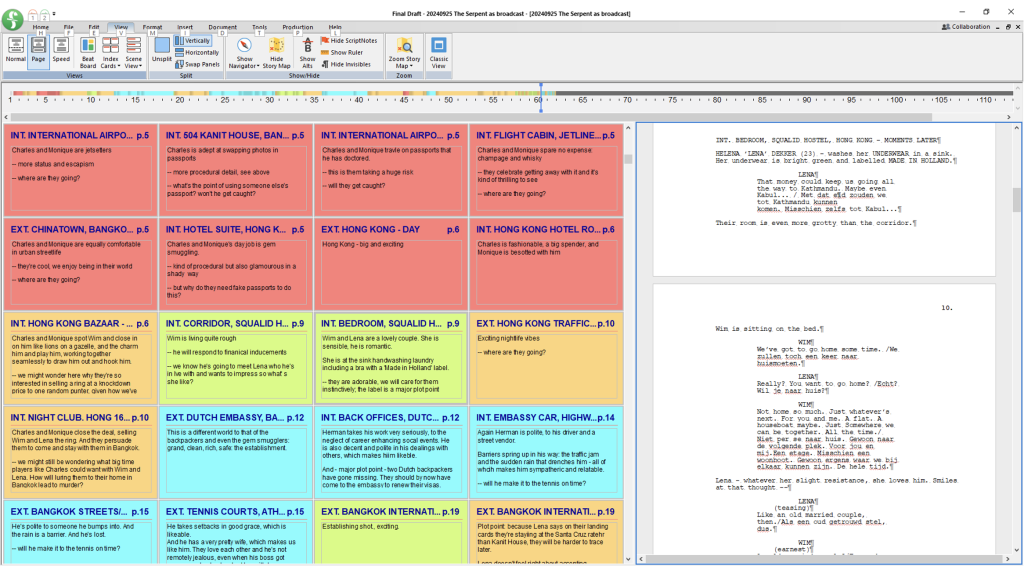
Then I went into the Index Cards view in Final Draft and wrote notes for every scene. I listed
- Logical Plot Points
- Emotional Beats
- Risks Taken by the main characters
- Barriers faced by them, and
- Giving new characters roles as they were introduced (Wizard, Gatekeeper, Antagonist etc).
The Drama Triangle
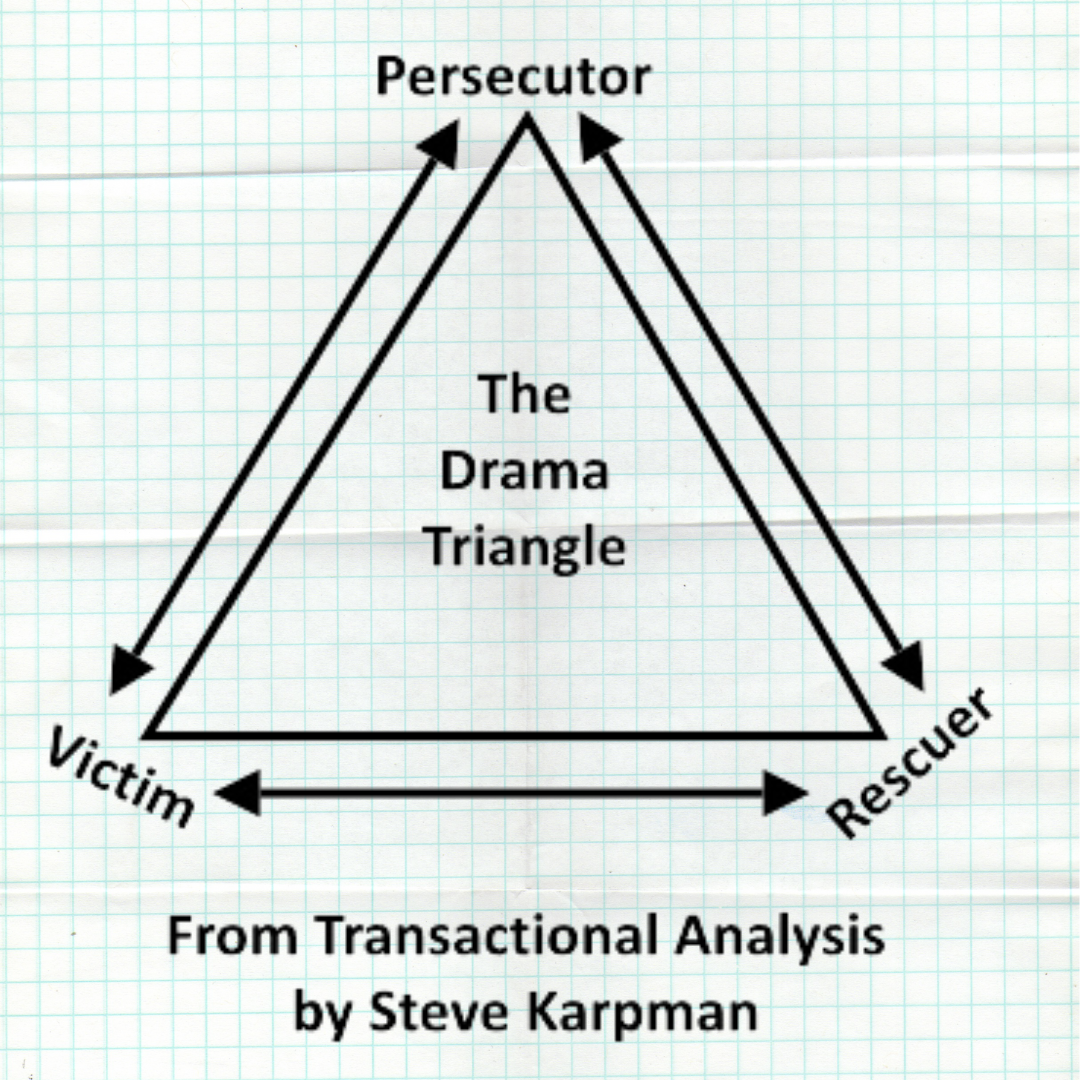
Lastly, I colour-coded the Index Cards to represent three story strands, which I based on Stephen Kapman’s ‘Drama Triangle’. This is whereyou analyse social situations by identifying three roles: Persecutor, Victim and Rescuer.
- The A story in The Serpent follows Antagonist, the ‘Persecutor’, the drink-spiking serial killer.
- The B story is about the Protagonist, the ‘Rescuer’, the Dutch diplomat who defies his bosses to pursue the Antagonist.
- The C story is about the ‘Victims’, the backpackers who the Antagonist befriends, drugs, robs and murders. The Victims spend a lot of time with the Persecutor, so I added an extra colour for a fourth story strand, A+C.
For good measure, I then put all of the scenes into their chronological order, in order to throw into sharper focus the thinking behind the plotting.
1) Making us care
In the shooting script, the Antagonist makes boastful hints about cloak-and-dagger activities in his past, and one of his sidekicks jokes about having been in prison.
The implication is that the backpackers find these red flags alluring and attractive, drawing them in and making them part architects in their grisly fates. This makes us feel slightly less sympathetic towards them.
i) Victim blaming isn’t cool
In the broadcast episode, the Antagonist doesn’t come across as dark and dangerous to the backpackers. They are drawn to him because he has cool parties and says he wants to help people fulfil their life potential. It’s easier to relate to the backpackers being taken in, and we care more about them.
ii) First impressions
We don’t meet the Protagonist until the 10th minute. But again, we get to know him and to like him very quickly. He’s working late at the office while all of his colleagues have left for a tennis club event. He’s more interested in finding two missing backpackers than laughing at the boss’s jokes over a G&T, so we admire him.
On his way to the tennis club, he encounters a series of barriers that he meets with good grace – traffic jams, getting caught in the rain, getting lost – and is unswervingly polite to his secretary, his driver, and to street vendors who slow him down.
iii) The Quest
The protagonist’s boss orders him to forget about the backpackers, rudely, in a way that humiliates the Protagonist in front of his wife. This means we know that he won’t; this is now his Quest. He’s more interested in doing the right thing than in pursuing promotion. This makes him a relatable, believable protagonist.i
iv) How did he do it – and was it fun?
Straight after the opening titles we get right into the glamourous side of the Antagonist’s life. He’s the king of the poolside party, glamourous, respected, having a good time; this is a world we’re going to enjoy getting to know. Three minutes in and we see the Antagonist crushing pills to slip into a drink for a backpacker whose money he then steals. It’s exhilarating and encouraging to get straight to this juicy stuff so quickly.
vi) Bad in a fun way
The question of how he did it is being answered already, and keeps us going past the ten minute mark. We’re kept interested by the procedural details, and by the thrill of seeing the Antagonist taking some very bold risks and then getting away with it. He’s not exactly likeable but he’s definitely fun to be with!

2) Maintaining a relentlessly compelling ‘Story Chain’
The Story Chain is how plotting goes from event to event, via ’cause & effect’. In The Serpent, every single scene in the script poses a question. I checked, and wrote the questions into the Index Cards in Final Draft.
Sometimes the questions recur, like ‘So where the heck are Wim and Lena?’ Sometimes they’re generic, like ‘Where are we now?’ or ‘Where are they off to now?’
But sometimes they’re emotional and character-specific. This includes ‘How long before Angela loses interest in Herman’s Quest?’
The Story’s Dramatic Questions
Every TV series has a central dramatic question. From the very first minute we have the key questions the audience will have, spelled out. The entire series will need to answer for us …
- ‘How did The Serpent do it?’ and
- ‘WHY did he do it?’ but mainly
- ‘How the hell has he managed to get away with it?’.
It doesn’t feel like an exposition dump partly because it’s so quick and efficient. We also relate to the CNN interviewer’s exasperation and disgust at the Antagonist’s insouciance.
3) Combining multiple nonlinear story strands
A lot of user critics and a few media critics complained about the constant time jumps. They definitely were disorienting in parts — but clearly deliberately so. Victims were sometimes stoned. Others were having semi-religious bliss experiences, or being disoriented by the Antagonist’s drugs and his cunning lies.
In addition, the Protagonist was often wrong-footed by the Antagonist’s tactic of stealing his Victim’s identities and travelling on their passports. This made it seem that people he’d murdered months previously were still alive.
This all totally fitted with the sometimes slightly dizzying time jumps.
Don’t Look Now
There’s a very cool nod to arguably the mother of all non-linear plots, Don’t Look Now. As one of the victims realises they’re just about to be murdered at the water’s edge, we flash back to them earlier on a boat. They are in a Buddhist temple, admiring a wall fresco of a fisherman casting a net from a little boat. In the very next scene, a real fisherman casts his net from a little boat just like the one in the fresco – and finds the victim’s floating corpse.

4) Providing the right amount of context
The episode as broadcast provides just the right amount of factual historical context to keep it feeling 100% real, and no more.
In the first minute, we’re introduced to the antagonist. We’re told that he topped Interpol’s Most Wanted List, and was of interest to TIME Magazine and CNN. He’s suspected of killing dozens of people but has escaped justice.
So we have clear answers to the channel surfer’s opening questions: ‘What’s it about?’ and ‘So what?’.
A time and a place
We see seventies fashion and seventies cars and telecommunications technology. There’s one quick conversation about nearby communist states. That’s all the context we have in the episode as broadcast.
In the shooting script there’s a lot more historical and political detail sprinkled into the dialogue. None of this is really needed.
In the episode as broadcast, the world of the story and the people in it feel real. But by keeping the context to a minimum, the story has the dreamy quality of one set ‘long ago in a faraway land’.
5) Reaching a satisfying conclusion which is ALSO a massive cliffhanger
The other big difference between the shooting script and the pilot as broadcast was to do with timing. It was a big improvement, I thought.
In the shooting script of The Serpent, the three plot strands each had one very dark moment. These occurred at different points in the episode, minutes apart … But in the broadcast episode, they three arrive almost on top of each other in the very last minute:
- (a) the antagonist drowns a backpacker whose drink he’d spiked,
- (b) in a flashforward, the protagonist comes across police photos of the burned and disfigured bodies of two other missing backpackers, and
- (c) in a very elegantly executed flashback, those same two backpackers, before they went missing, start to suspect that they’ve been drugged.
Bang-bang-bang!
Here’s a screenshot of my recreation of the script of the pilot of The Serpent as it was broadcast, with my notes in the Index Cards. Pls ping Lucy @B2W if you’d like a copy.
BIO: Neil Weatherall has written four plays, three of which have had successful fringe run, plus a novel that he is planning to turn into a graphic novel using Midjourney and Stable Diffusion. Primarily a storyteller, he also storyboards, produces, directs, and edits. CONNECT WITH HIM HERE.
Wow, thanks Neil!!!
Fantastic case study of The Serpent here. Don’t forget you can check out the other case studies on the site, HERE. If you want to break down your favourite show, genre, characters or something else — get in touch!

Voracious and passionate. Super!
Yes, Neil did a brilliant job!