

What Is The Passive Voice?
The passive voice is a grammatical construction in which the subject of a sentence is acted upon by the verb, rather than performing the action itself. This results in a less direct, often more ambiguous sentence structure.
This does NOT mean the passive voice is automatically ‘wrong’, but when it comes to writing fiction, it might not be desirable. But what does it look like? Here you go …
Passive Voice example: The book was written by Lucy V Hay
(By the way, it’s not tense-dependent. It would still be passive if it said, ‘The book is written by Lucy V Hay’).
In this sentence, ‘the book’ is the subject that is receiving the action of being written by Lucy. In other words, the focus is on the book being acted upon rather than on who is performing the action (Lucy V Hay).
But what is the opposite of the passive voice? You guessed it: the ACTIVE voice!
So as contrast, an active voice version of the same sentences would be:
Active Voice: Lucy V Hay wrote the book
(Again, it would still be active if it was in present tense and said, ‘Lucy V Hay writes the book’).
In this active construction, Lucy V Hay is the subject performing the action of writing the book, resulting in a clearer and more direct sentence.
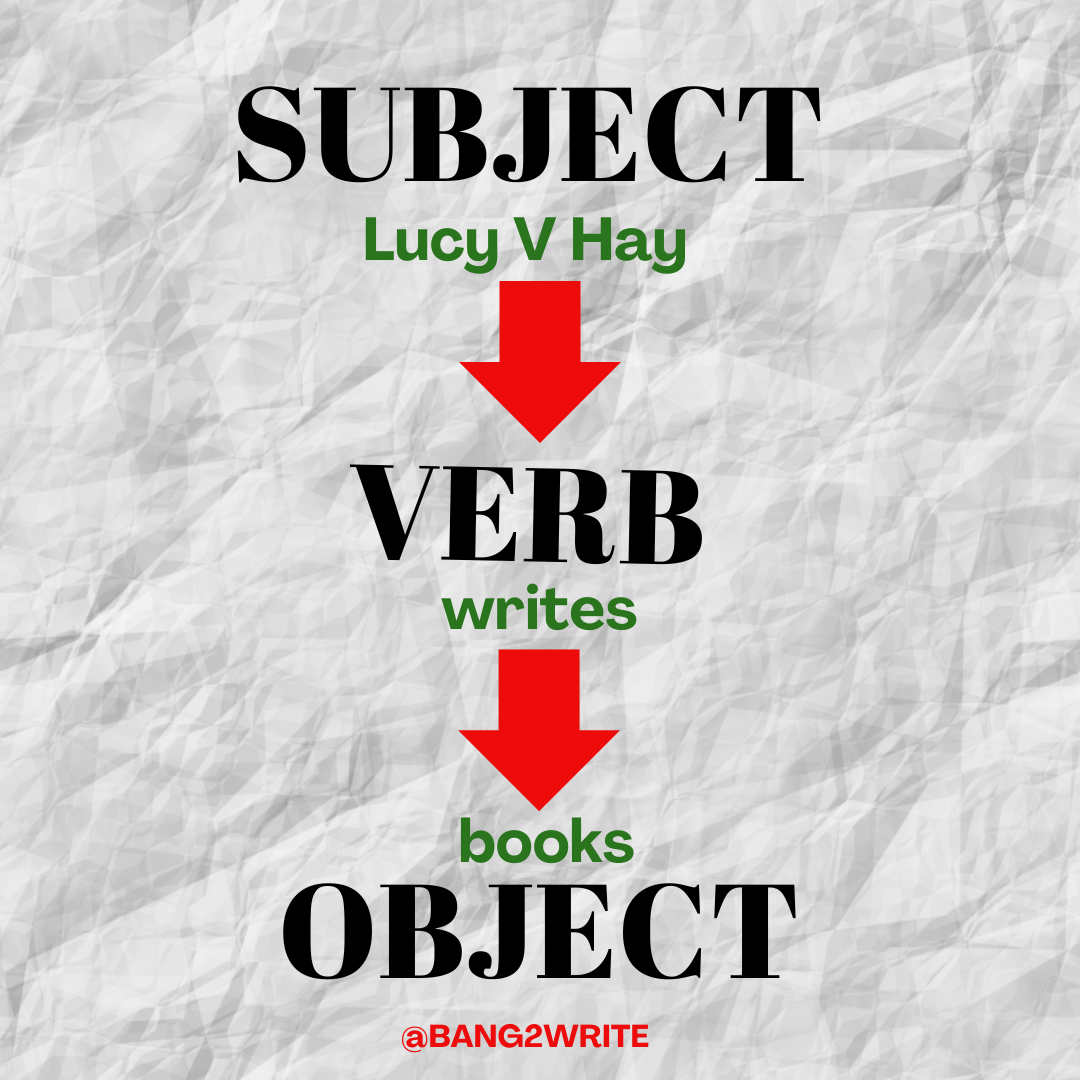
Wait a minute, wait a minute — Subject?? Object?? WTAF??
I know, I know … lots of us never got a proper education in grammar thanks to governments mucking around with curriculums. So let me break it down even further for you.
Sentence construction in English uses the subject-verb-object (S-V-O) structure. This S-V-O structure provides a clear and straightforward way to convey information in a sentence.
S-V-O also helps to establish a logical flow of information. It makes it easier for readers or listeners to understand the relationship between the elements of the sentence.
What this all means is the subject performs the action on the object of the sentence …
- Subject = typically the doer of the action
- Verb = it’s a doing word, right? Aka the action being performed
- Object = receives the action
So, to illustrate all this, let’s go back to the ACTIVE sentence:
Lucy V Hay wrote the book.
- Subject = Lucy V Hay (the doer of the action)
- Verb = wrote (action being performed)
- Object = the book (receives the action)
Now let’s compare it to the PASSIVE version of the same sentence:
The book was written by Lucy V Hay.
- Subject = the book
- Verb = written
- Object = Lucy V Hay
So, as you can see – the passive voice happens when the subject and object of a sentence get reversed! That’s okay for term papers, blog articles or non fiction, plus obviously you will use *some* passive voice in your novel.
However, it’s unlikely you will want to use LOTS of passive voice in your fiction. This is why I always recommend authors use editing tools such as HemingwayApp. (It’s free and SUPER useful).

1 Weird Trick To Avoid The Passive Voice
In recent years, B2W has been working with a lot of authors on their novels. One thing many writers struggle with is overusing the passive voice, especially because they find it very hard to spot.
So here’s a handy tip that frequently does the rounds on Twitter to test your writing (as a bonus, it’s pretty funny). If you are afraid your sentence is in the passive voice, simply do this …
Add the phrase, ‘by zombies’
If your sentence still makes grammatical sense, it’s in the passive voice.
I know that sounds odd, so let me demonstrate how this would work in the passive voice:
- The treasure map was found in the attic by zombies.
- Graffiti had been scrawled all over the wall by zombies.
- The brains have all been eaten by zombies.
But how would the same sentences look in the active voice? Check this out:
- Zombies found the treasure map in the attic.
- Zombies scrawled the graffiti all over the wall.
- Zombies have eaten all the brains.
Because Zombies are now the subject, they have to move towards the front of the sentence for whatever they’re doing (verb) to the object (treasure map / graffiti / brains) to make sense … plus we have to get rid of ‘by’ altogether (since ‘be’ is an important part of the passive voice). That’s how we know these sentences are in the active voice.
Last Points
Using ‘by zombies’ is a great little trick to keep in your writing toolbox. It’s memorable and simple, meaning you can always double-check your novels and short stories.
Just make sure you also remember how the S-V-O sentence construction works. Plus make use of free editing tools like Hemingway App. Just don’t go overboard — use of some passive voice in your fiction is ALWAYS okay.
Good luck!
Want More Help Writing Your Novel … AND Getting It Published?
 Don’t miss the early bird offer for The Complete B2W Fast Track: Novel Writing!Ahead of Black Friday, this is your chance to grab the lowest price this course will everbe.
This step-by-step programme takes you from blank page to finished draft — and beyond! You’ll master character, plotting, dialogue, voice, theme and rewriting, plus get insider know-how on submissions, agents, publishing, marketing and even adapting your work!
This isn’t just about writing a novel — it’s about building a career. But the Early Bird rate won’t stick around. Lock in your place now before the price goes up!
CLICK HERE for more info, or click on the pic on the right.
